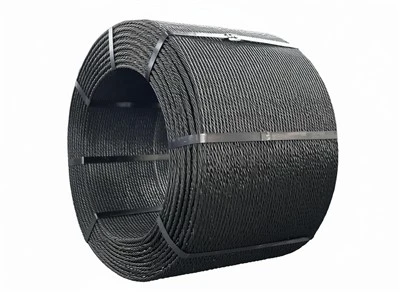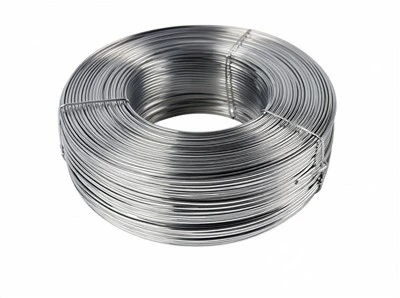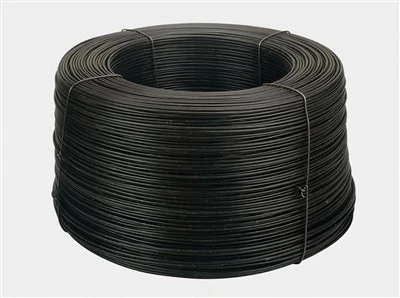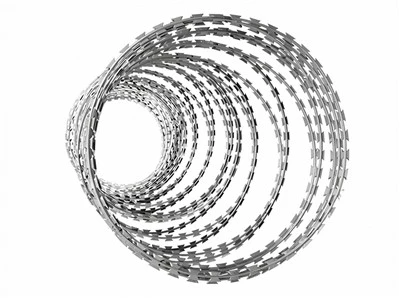

Galvanized wire consists primarily of a steel wire core and a surface zinc coating; the core is typically manufactured from high-quality low-carbon steel. Iron (Fe) is the main constituent, usually accounting for over 98% of the mass, alongside small amounts of elements such as carbon (C), manganese (Mn), silicon (Si), phosphorus (P), and sulfur (S). Specifically, the carbon content generally ranges from 0.06% to 0.25%, manganese from 0.30% to 0.80%, and silicon typically does not exceed 0.30%, while phosphorus and sulfur levels are kept below 0.045% to ensure the wire possesses good strength, ductility, and workability.
The zinc coating is composed mainly of zinc (Zn), with a content typically no lower than 99%; industrial production commonly utilizes zinc ingots with a purity exceeding 99.95% as raw material. Coating thickness varies depending on production processes and application requirements: hot-dip galvanized wire generally features a coating weight of 40–300 g/m² and offers strong corrosion resistance, whereas electro-galvanized wire has a relatively thinner coating-typically 10–30 g/m²-but boasts a smoother, more uniform surface, making it suitable for products where appearance is a priority.
To enhance coating quality and performance, some galvanizing processes involve adding trace amounts of alloying elements-such as aluminum (Al), nickel (Ni), or bismuth (Bi)-to the molten zinc bath, usually at concentrations between 0.01% and 0.20%. These trace elements improve the fluidity, adhesion, and surface quality of the zinc coating, thereby endowing the galvanized wire with superior corrosion resistance, mechanical properties, and service life.